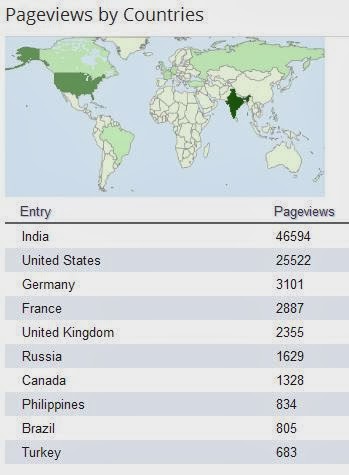
Very happy to share below visitor statistics till date from startup in 2009 of ChennaiHamsBlogspot which is really encouraging for us to continue to put efforts to improve this free forum further so that this wonderful hobby keeps growing to greater heights . Total visitor count has crossed 1 lac+ visitors and continues to grow day by day and more exciting is that fact that amatuer radio lovers from around 169 countries across the world have visited the blog so far and enjoyed the knowledge/info shared . From a humble beginning in 2009 , we thank everyone who visited and continued to visit the blog
Jan 11, 2014
The famous World War II Marconi R1155 Communications Receiver!!!!
The Marconi R1155 is a World War II era receiver produced for the British Royal Air Force. It was used in Lancaster and Halifax bombers and includes special circuitry for direction finding.
The R1155 tunes longwave down to 75KHz and shortwave up to 18MHz, with a couple of gaps along the way. Fortunately the broadcast band is covered from 600KHz to 1500KHz, so there is still something to tune in today. Aside from the DF circuitry it's a fairly standard multi-band super-het with one RF stage, mixer-oscillator, two IF stages, detector, one audio stage, and a magic-eye tuning indicator.
An audio power output stage was not included as the receiver was only used with headphones originally. There is no internal power supply as B+ and filament power were supplied from an external source when installed in an aircraft. The unit below the receiver in the photo is a home-made power supply and audio amplifier, described further below.
Many of these receivers were sold as surplus after the war. In Canada they were sold by the War Assets Corporation (see advertisement: XTAL, Jan 1947). They were commonly purchased by hams. Many of them were then extensively modified, typically by removing the DF circuitry and/or installing a power supply or audio amplifier inside.
Jan 4, 2014
Titanic's Marconi Wireless Room (set) video Tour
This is the main set for our upcoming film "The Last Signals". The film is an entirely factual depiction of the sinking from Harold Bride's point of view and the film will play out exactly how the real disaster did.
This set took many months of research and labor to make, and nearly $2,000. It will be flooded and destroyed on camera
Jan 3, 2014
The Titanic radio department - a brief background!!!!
The Titanic radio department in 1912- a brief background
The Titanic's "wireless" equipment was the most powerful in use at the time in 1912 . The main transmitter was a rotary spark design, powered by a 5 kW motor alternator, fed from the ship's lighting circuit.
The equipment operated into a 4 wire antenna suspended between the ship's 2 masts, some 250 feet above the sea. There was also a battery powered emergency transmitter.
The main transmitter was housed in a special room, known as the "Silent Room". This room was located next door to the operating room, and specially insulated to reduce interference to the main receiver.
The equipment's guaranteed working range was 250 miles, but communications could be maintained for up to 400 miles during daylight and up to 2000 miles at night.
In charge was 25 year old John (Jack) G. Phillips (left), with 21 year old Harold Bride (right) as the deputy or second R/O. The R/O's remained at their posts until about 3 minutes before the vessel foundered... even after being released from their duties by the Captain.
Harold Bride remarked that water could be heard flooding into the wheelhouse as he and Jack Phillips abandoned the radio room. Jack Phillips was still sending as the power supply to the radio room failed...
The Titanic Radio Officers did great honour to their profession.
Jack Phillips died of hypothermia on or near Collapsible lifeboat B - his body was never recovered......
Harold Bride left the sea after WW1, and faded into obscurity. He died in Scotland in 1956.
The left hand photo actually shows the Marconi wireless Room of the Titanic's sister ship Olympic, with Radio Officer Brent receiving a message.
In the right hand picture Phillips and another R/O (NOT Harold Bride) are shown on the White Star vessel "Adriatic " (both photos from the Father Browne collection).
Olympic's Marconi Room - taken on her maiden voyage. Note the external porthole in the centre of picture.
Titanic's Marconi Room was located inboard (more detail later).
The Titanic Marconi room set from the James Cameron movie.
This set quite accurately portrays Titanic's sister ship Olympic's Marconi Room.
The Titanic set was based on archival pictures of Olympic, with the window omitted (see the Olympic photo below).
Another view of the Titanic radio room set from the James Cameron movie.
Clearly, no expense has been spared...note the Marconi uniform cap on the operating desk.
A Marconi wireless telegram from the RMS Olympic, Titanic’s sister ship, reports the Carpathia’s rush to the site where the Titanic went down.
"Found boats and wreckage only," it says in part. "About 675 souls saved crew and passengers.
NOSTALGIC MEMORIES : On 12 December 1901 radio crossed for the firsttime across the Atlantic THE ATLANTIC
On 12 December 1901, Guglielmo Marconi received a radio signal that had been sent by his colleagues across the Atlantic. Although wireless telegraphy was not new - it had started to be used commercially by coastal shipping three years previously - Marconi's demonstration was exceptional.
To begin with, there was no reason to suppose that a radio signal would follow the curvature of the earth. As an eminent scientist said at the time, "there is a mountain of water one hundred miles high to be got over, and electric waves tend to go straight".
Despite this, Marconi - at 27 years of age - persuaded the hard-headed directors of his newly formed Wireless Telegraph Company to invest �50,000 and a lot of time in the experiment. This was a considerable investment - equal to several millions of pounds today - by a small company still existing on its capital.
Marconi's confidence was based on his experience of radio transmissions around England1, to France and to an experimental station in the south west of Ireland. For the Atlantic attempt, he set up a new station at Poldhu in Cornwall. His aerial comprised twenty-four ships' masts each 200 feet high, and the transmitter was powered by a 32 brake horsepower engine driving a 25 kilowatt alternator whose 2,000 volts were then boosted to 20,000 volts. At the receiving end, in St John's Newfoundland, Marconi waited with kites and balloons to hold an aerial wire aloft. In the event, a kite with 500 feet of wire received the first signals - the three dots of the Morse code letter S
Public reaction was mixed. The Daily Telegraph reported, "The view generally held is that "electric strays" were responsible for activating the delicate instrument" while The Times and the technical press - despite accepting that the message had been sent - were doubtful that transatlantic wireless communication had any practical application.
|
Better news, however, came in an unlikely form. The Anglo-American Telegraph Company immediately wrote to Marconi saying that it had a monopoly on communications in Canada's Newfoundland and Marconi was to stop transmissions immediately. This he did, and was immediately courted by Canadian and United States authorities incensed by the company's attitude, and keen to be involved in a technology that they recognised as having great potential.
Progress in those early days was rapid. When Marconi returned to New York from Southampton in late February on the SS Philadelphia, he maintained readable messages with Poldhu up to 700 miles out by day, and 1,500 at night. The letter "S" was received 2,100 miles out, despite the limited aerial rigged on board.
| ||||||||
Although there were theories explaining why radio signals did not ignore the curve of the earth and disappear into space, it was not until 1924 that the existence of the ionosphere was discovered - bouncing them back to the ground. By then, transatlantic wireless communication was commonplace, and the first signal to be sent successfully around the globe - a possibility predicted by Marconi - was demonstrated two years later.
Marconi was born in 1874 in Bologna, Italy, studying Heinrich Hertz's theory of radio there and demonstrating its practice in experiments around the family home. He moved to Britain and filed his first patent in 1896, forming a company in 1897 which became Marconi's Wireless Telegraph Company (eventually Marconi plc) three years later.
The first advertised broadcast in Britain - using a Marconi transmitter - was made in 1920, and the first microwave telephone link was established by Marconi in 1932 between the Vatican and the Pope's summer residence. At that time Marconi was also demonstrating the potential of blind navigation, the forerunner of radar.
Marconi returned to Italy in 1935, and died there in 1937. In a tribute, wireless stations throughout the world observed two minutes silence and the radio spectrum was as silent as it had been forty years before.
|
The 700 people saved from the Titanic were "saved through one man, Mr. Marconi"
Jan 2, 2014
Another feather in Chennai's HAM cap : 4th VHF repeater (Vandu Net Repeater) Installed
VANDU NET WISHES YOU AND YOUR FAMILY A VERY HAPPY AND PROSPEROUS NEW YEAR!
We are happy to inform that one more repeater has been installed in Chennai.
Name of the Repeater: Vandu Net Repeater
Call Sign : VU2 LHS
Frequency : 145.550 MHz (Negative Shift)
Active from: 03-JAN-2014 for all HAMS
The Maha Meet Net Contest which was running at 144.900 MHz simplex is being shifted to Vandu Net Repeater from 03-JAN-2014. The timing is 21:15 to 21:45 hours. Please note the above change and continue to extend your active participation and cooperation.
73's
Anna (VU2KBX)
Nov 25, 2013
Update from Agatti on VU7AG Progess!!!!!
The team reports that all is going well barring the internet connection which has been a real let down. Log uploads to Clublog are proving to be very tedious. All the logs are intact but not all are on the Clublog server. Seems some 30m QSOs are missing and these would be looked into. The team would be setting up the 160m top-loaded vertical today. The last of the antennas to go up would be a Spiderbeam which will be used for the third station. VU2PAI and VU3DMP join the team tomorrow. All three stations should be QRV from tomorrow afternoon, approximately 1200z onwards.
The team continues to focus on NA and alternates between working EU and NA, especially on the short path. They request co-operation from EU when they are working NA and SA which has the largest population of hams requiring VU7 for a new one. The feedback received so far has been passed on to the team and they will pay closer attention to certain band openings.
The team spent the better part of the weekend installing antennas. They now have phased verticals for 80, 40 and 30m apart from a Hexbeam, a 2el Steppir beam and Butternut verticals. They reported working NA on 40 and 75m SSB last night . More pictures awaited whenever they are able to get a stable internet connection.
Also some live photos taken by the team till date as below.
The Agatti airport entrance , possible the smallest airport anywhere in India
The approach view of the Agatti airport/Island
All the gear being loaded onto motor vessel at Mangalore
The beauty of Agatti as a tropical Paradise
Further info available in www.vu7ag.info , we will keep updating further as well.
VU7AG DX Lakshadweep Islands active!!!!!
A team of amateur radio operators are now active as VU7AG from Agatti Island (AS-011) until December 10th.
Agatti is one of the islands of Lakshadweep group formerly known as the Laccadive, Minicoy, and Amindivi Islands is a group of islands in the Laccadive Sea, 200 to 440 kilometres (120 to 270 miles) off the south western coast of India. The archipelago is a Union Territory and is governed by the Union Government of India. They were also known as Laccadive Islands, although geographically this is only the name of the central subgroup of the group. Lakshadweep comes from "Lakshadweepa", which means "one hundred thousand islands" in Sanskrit as well as many Indian languages like Hindi, Malayalam, Kannada, Telugu and others. The islands form the smallest Union Territory of India: their total surface area is just 32 square kilometres (12 sq mi). The islands are the northernmost of the Lakshadweep-Maldives-Chagos group of islands, which are the tops of a vast undersea mountain range, the Chagos-Laccadive Ridge.
CW - 1812, 3512, 7012, 10112, 14012, 18082, 21012, 24902 and 28012 kHz
SSB - 3680, 7095, 14180, 18155, 21280, 24955 and 28480 kHz
RTTY - 3584, 7032, 10142, 14082, 18092, 21092, 24922 and 28092 kHz
They will always be operating split.
Please listen to operator instructions carefully.
CW: 2-10 KHz up SSB: 5-15 KHz up RTTY: 2-10 KHz up
The pilot stations have been announced: Stan/KH6CG (Chief Pilot
+ Asia/OC), Gary/DF2RG (EU), Luc/LU1FAM (Central & South America), Mark/N1UK (NA East Coast) and Rich/KY6R (NA West Coast). They also have an ePilot on their Web site through which DXers can get in touch with them.
The Propagation page now includes custom propagation charts thanks to Stu, K6TU, and his wonderful propagation service.
Another callsign has been issued for demonstration purposes on Kavaratti Island VU7KA. This would be used only briefly when team members make presentations to the local administration in Kavaratti and educate them on amateur radio.
QSL Manager is Krish, W4VKU, direct or by the Bureau (see details on the Web page). An Online QSL Request System (OQRS) will be available for all your QSL requests. OQRS will be enabled soon after the expedition. For Logbook of The World (LoTW): QSOs would be uploaded
to LoTW in approximately 6 months time.
The following Web page has been set up and contains bios of operators, QSL details, frequencies and a survey.
Visit the VU7AG page at: http://www.vu7ag.info
Oct 7, 2013
Something which could impact telecommunications : Sun set for 11-year magnetic pole flip!!!!
A special event is about to occur in our sun, and it could impact our lives. The magnetic poles of the sun — which are like the ends of a giant bar magnet — are about to flip, that is, the polar north will become the polar south and vice versa . According to scientists at the Wilcox Solar onservatory at Stanford University , the sun could be barely two to three months away from this magnetic field reversal. The change is periodic, taking place once every 11 years or so.
The flip also corresponds with peak activity during the 11-year solar cycle. This is when sunspots — intense magnetic field flu ctuations that appear as dark spots on the solar surface — are highest in number. "When the number of sunspots is highest, a time known as the solar maximum, the sun's large-scale dipole magnetic field starts reversing. This reversal is akin to sun'smagnetic poles flipping. It's almost as if a giant magnet inside the sun was turned upside down," said Dibyendu Nandi, an a strop hysicist at Kolkata's Indian Institute of Science Education and Research.
Why does this flip take place? Nandi said that the periodic reversal was linked to the motion of plasma flows inside the sun. The flow of this hot, electrically-charged material tosses and turns one component of the magnetic field into another, eventually changing the sun's dipole field. "This process is technically known as the solar dynamo mechanism and can be studied using computer models which we do in our laboratories," Nandi said. Changes in the sun's magnetic field ripple through the solar system and beyond, a region known as the heliosphere. The weather in space is expected to be most hazardous in the next few months as the flip begins to take place, Nandi said.
"The chances of solar magnetic storms occurring are also high. These storms carry a vast amount of charged particles and magnetic fieldsthrough interplanetary space and can pose a threat to satellite operations , telecommunications , air traffic on polar routes and power grids in countries at high latitudes ," the scientist said.
Scientists are watching the event closely to fully understand the changes that take place. It's also of special interest because the current solar cycle — the 24th since 1755, when sunspot activity began to be recorded — is one of the weakest in 100 years. A strong solar magnetic field also acts as a shield against cosmic rays coming from outer space. "Due to the current weak cycle, we have been recording high cosmic ray influx since 2009," said B N Dwivedi of IIT-BHU.
In India, solar magnetic fields are being observed from the solar observatories at Udaipur and Kodaikanal. Then there are theoretical astrophysicists such as Nandi who build computer models to study and predict solar behaviour.
For HAM enthusiasts this would impact upper HF and VHF radio propagation, but might be good and save us from ourselves and the outrageous climate change that we are living through. Or at least slow it down.
The flip also corresponds with peak activity during the 11-year solar cycle. This is when sunspots — intense magnetic field flu ctuations that appear as dark spots on the solar surface — are highest in number. "When the number of sunspots is highest, a time known as the solar maximum, the sun's large-scale dipole magnetic field starts reversing. This reversal is akin to sun'smagnetic poles flipping. It's almost as if a giant magnet inside the sun was turned upside down," said Dibyendu Nandi, an a strop hysicist at Kolkata's Indian Institute of Science Education and Research.
Why does this flip take place? Nandi said that the periodic reversal was linked to the motion of plasma flows inside the sun. The flow of this hot, electrically-charged material tosses and turns one component of the magnetic field into another, eventually changing the sun's dipole field. "This process is technically known as the solar dynamo mechanism and can be studied using computer models which we do in our laboratories," Nandi said. Changes in the sun's magnetic field ripple through the solar system and beyond, a region known as the heliosphere. The weather in space is expected to be most hazardous in the next few months as the flip begins to take place, Nandi said.
"The chances of solar magnetic storms occurring are also high. These storms carry a vast amount of charged particles and magnetic fieldsthrough interplanetary space and can pose a threat to satellite operations , telecommunications , air traffic on polar routes and power grids in countries at high latitudes ," the scientist said.
Scientists are watching the event closely to fully understand the changes that take place. It's also of special interest because the current solar cycle — the 24th since 1755, when sunspot activity began to be recorded — is one of the weakest in 100 years. A strong solar magnetic field also acts as a shield against cosmic rays coming from outer space. "Due to the current weak cycle, we have been recording high cosmic ray influx since 2009," said B N Dwivedi of IIT-BHU.
In India, solar magnetic fields are being observed from the solar observatories at Udaipur and Kodaikanal. Then there are theoretical astrophysicists such as Nandi who build computer models to study and predict solar behaviour.
Sep 30, 2013
Monthly September 2013 meeting of MARS organised!!!!!
The monthly meeting of MARS was held in the conference hall
of AASI, Mount Road on the 28th of September. The meeting was
presided by OM Balu-VU3CBM. Field Day was proposed to be held on 6th,7th and 8th
of December
in Yelagiri Hills.
Since sufficient time to plan has been given, good number of
members is expected to participate. A mini (Fun) FOX Hunt will be conducted
during the Field day. The regular Fox hunt will be conducted in the month of
February.
Prizes were distributed for the August Check-In 2012. Also
prizes for the August Check-In Contest – 2013, conducted by the VHF group of
Chennai, Was given by MARS.
Photos taken during the meeting can be seen at the following link MARS MEETING 28th September 2013
Regards
VU2VAU Srini / ChennaiHamsBlogspot Team
Sep 23, 2013
HAMFESTINDIA 2014 to be held at Hyderabad!!!!
It has be finalized at the recently held 2013 HamfestIndia at Gwalior that the 2014 HamFestIndia will move back South to the pearl city of "Hyderabad".
Hyderabad is the capital and largest city of the southern Indian state of Andhra Pradesh . Occupying 650 square kilometres (250 sq mi) along the banks of the Musi River, it has a population of 6.8 million and a metropolitan population of 7.75 million, making it the fourth most populous city and sixth most populous urban agglomeration in India. At an average altitude of 542 metres (1,778 ft), much of Hyderabad is situated on hilly terrain around artificial lakes, including Hussain Sagar—predating the city's founding—north of the city centre.
More details to follow through, keep visiting this blog.
Aug 20, 2013
May 5, 2013
VU2JTJ Thiagarajan becomes Silent Key!!!!
Vu2 JTJ Thiagarajan (affectionately called Thiagu) was a well known ham in the amateur radio community . He got his licence about 25 years back and was active throughout .The last ham event he participated was Hamfest 2012. His dream project was to have a repeater installed near Maduranthakam near Chengalpattu dist and he worked so hard to get the land near the town for the repeater site . Both his wife and daughter are also call sign holders.
Our heartfelt condolences to the family & all of us would miss you so much "Thiagu".
May your soul rest in peace.
Regards
ChennaiHamsblogspot Team
Apr 6, 2013
HAM Radio shop in Japan : Take a look to see how a Paradise on earth for a Amateur Radio operator will be!!!!
The below Video can drive any Amateur Radio Operator/radio lover nuts!!!and if he is in restricted country like India where we cannot even dream of a shop like , this is the paradise every Indian HAM can dream to go sometime and burn his coffers. Pls see the Video and just look at the whole range of amazing products.
This shop is located in Akihabara Electric Town is a district of Tokyo, Japan. It is located less than five minutes by rail from Tokyo Station. Its name is frequently shortened to Akiba in Japan.
Akihabara is a major shopping area for electronic, computer, anime, games and otaku goods, including new and used items
Apr 4, 2013
Ham radio from the Antarctica area!!!!!
Amateur radio or ham radio call signs are unique identifiers for licensed operators in
Antarctica. Call signs are regulated
internationally by the ITU
as well as nationally by governing bodies within each country who may have
nationals operating in Antarctica. Call signs may also be issued by a local
Antarctic authority (i.e. base commander) who chooses from a block reserved by
their national body for that purpose. The Antarctic
Treaty signed on December 1, 1959 (and entered into force on June 23, 1961),
established the legal framework for the management of Antarctica, including
allocation of amateur call signs.
The Video is a tribute to all those who have worked on HAM Radio in the white continent:
Although Antarctica is considered international by treaty, amateur radio operators in Antarctica are often subject to the reciprocal licensing requirements pertaining to the country under which the camp is flagged.
The Worldwide Antarctic Program keeps a list of special event call signs
issued from various countries at various times. TM4IPY was issued in
2007 by France to celebrate the International Polar Year as was
IAØIPY, IA8IPY, IA7IPY & IP7IPY by Italy, GB4IPY by The United Kingdom,
VYØICE/VE2 in Canada, LZØ7IPY in Argentina, EV5IPY in Belarus, CQ4IPY in
Portugal, SNØIPY in Poland, YE2IPY in Indonesia, S5ØIPY in Slovenia, 5DØIPY in
Morocco, and others. These callsigns were used by amateurs in their home
countries.
Subscribe to:
Posts (Atom)


.jpg)